ADHD Makeup Organization: Systems That Actually Work
Look, if you have ADHD and you’re reading an article about makeup organization, chances are you’ve already tried to “get organized” at least three times this month. Maybe you bought matching containers that are now sitting empty in a cabinet somewhere. Or you created an elaborate color-coded system that lasted exactly two days before everything went back to being a chaotic pile.
I get it. I really, really get it.
Here’s the truth about organizing makeup with ADHD: traditional organization advice doesn’t work for us. Those beautiful Pinterest-perfect vanities with everything tucked away in drawers? That’s a recipe for “out of sight, out of mind” disaster. Those multi-step organizational systems? Yeah, we’re not going to maintain those.
But that doesn’t mean we’re doomed to live in perpetual makeup chaos. It just means we need to work with our ADHD brains instead of against them.
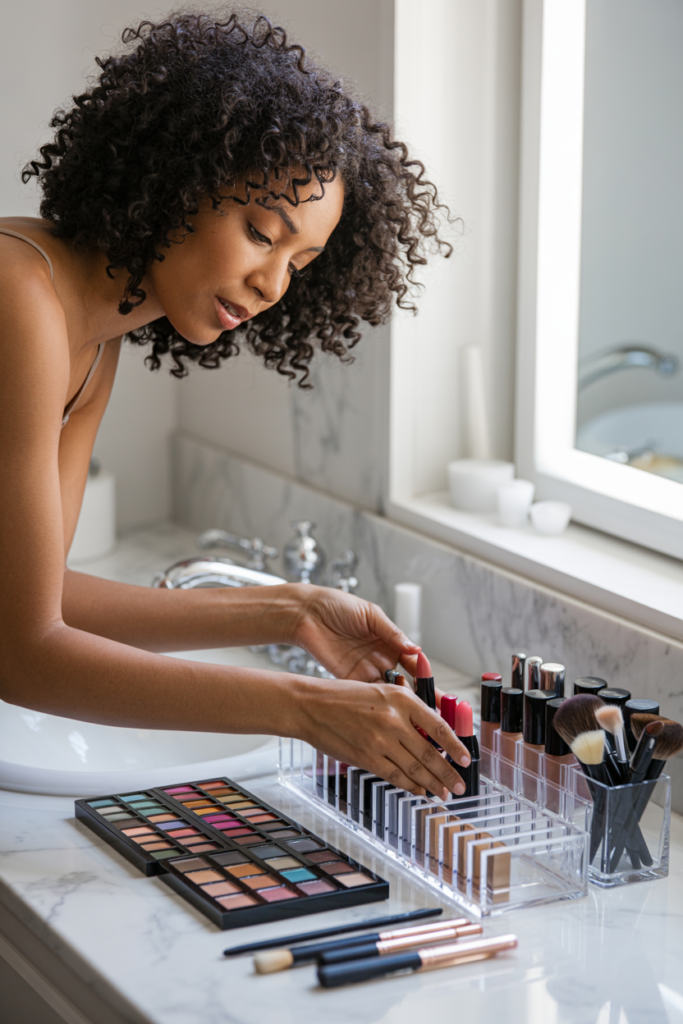
Why Traditional Organization Fails ADHD Brains
Before we dive into solutions, let’s talk about why typical organization advice makes things worse for those of us with ADHD.
First, there’s the “out of sight, out of mind” problem. When neurotypical people say “store things in drawers to reduce visual clutter,” they’re not thinking about how ADHD brains work. If we can’t see it, it literally doesn’t exist. I once forgot I owned a perfectly good foundation for six months because it was in a drawer. Six months!
Then there’s decision fatigue. Having too many options is overwhelming, but so is having a complicated system for accessing those options. If your organizational system requires you to open three different containers and remember which drawer holds what, that system is already dead.
And don’t even get me started on maintenance. Any organization system that requires constant upkeep is going to fall apart the second life gets busy or we’re having an off day. We need systems that work even when we’re functioning at 60%.
Finally, there’s the shame spiral. We beat ourselves up for being “messy” or “disorganized,” which makes the whole thing feel even more overwhelming. But here’s the thing—disorganization isn’t a moral failing. It’s just how our brains are wired, and we can work with that.

The Core Principles of ADHD-Friendly Makeup Organization
Okay, so what actually works? These are the principles that have made the biggest difference for me and countless other ADHD folks I’ve talked to:
Everything Must Be Visible
This is non-negotiable. If you can’t see it, you won’t use it. Period. That means clear containers, open storage, and products displayed where you can actually see them. Yes, it might look “cluttered” to other people, but functionality beats aesthetics every single time.
Reduce Steps to Zero (Or As Close As Possible)
The fewer steps between you and your makeup, the better. No lids to unscrew. No drawers to open. No bins to pull out and then push back in. Just grab and go.
Make It Error-Proof
Your organization system needs to work even when you’re rushing, stressed, or distracted. That means products should be hard to knock over, spills should be easy to clean up, and there should be minimal ways to “do it wrong.”
Embrace Visible Reminders
If you need to remember to take your makeup off at night, that makeup remover needs to be staring you in the face. If you’re trying to use a certain product more often, put it front and center. Use your ADHD tendency to focus on what’s in front of you as a feature, not a bug.
Accept That “Perfectly Organized” Isn’t The Goal
The goal is functional. The goal is being able to find what you need. The goal is not feeling overwhelmed every time you look at your makeup. If that means your setup looks different from Instagram-perfect vanities, who cares?
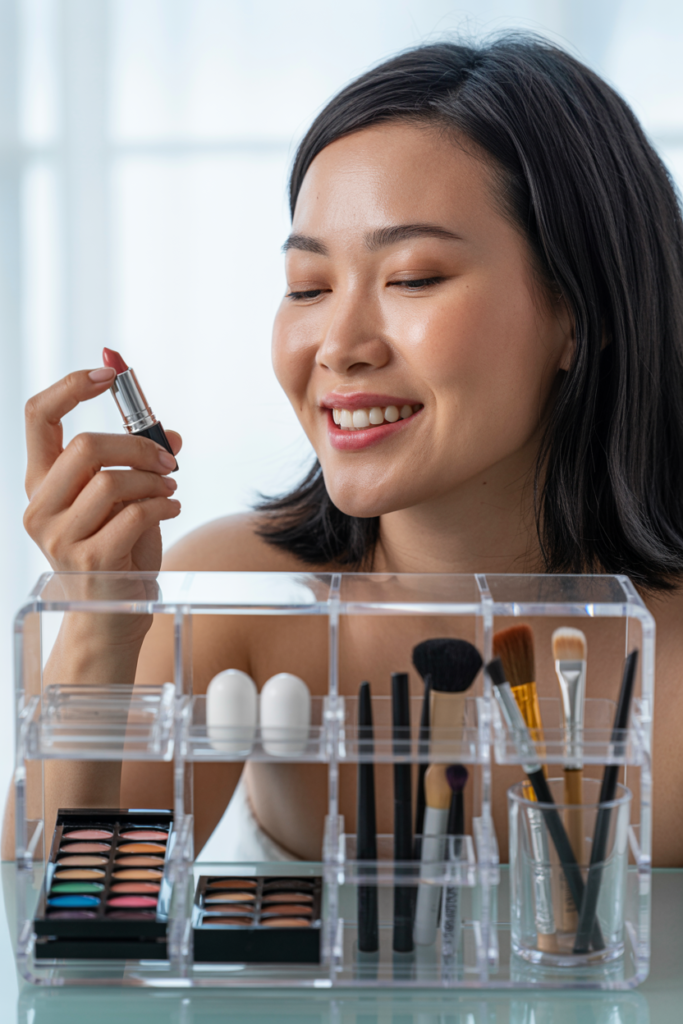
The Best Organization Systems for ADHD
Now let’s get into specific setups that actually work. I’ll walk you through different approaches depending on your space, collection size, and specific ADHD challenges.
The “Everything Visible” Countertop System
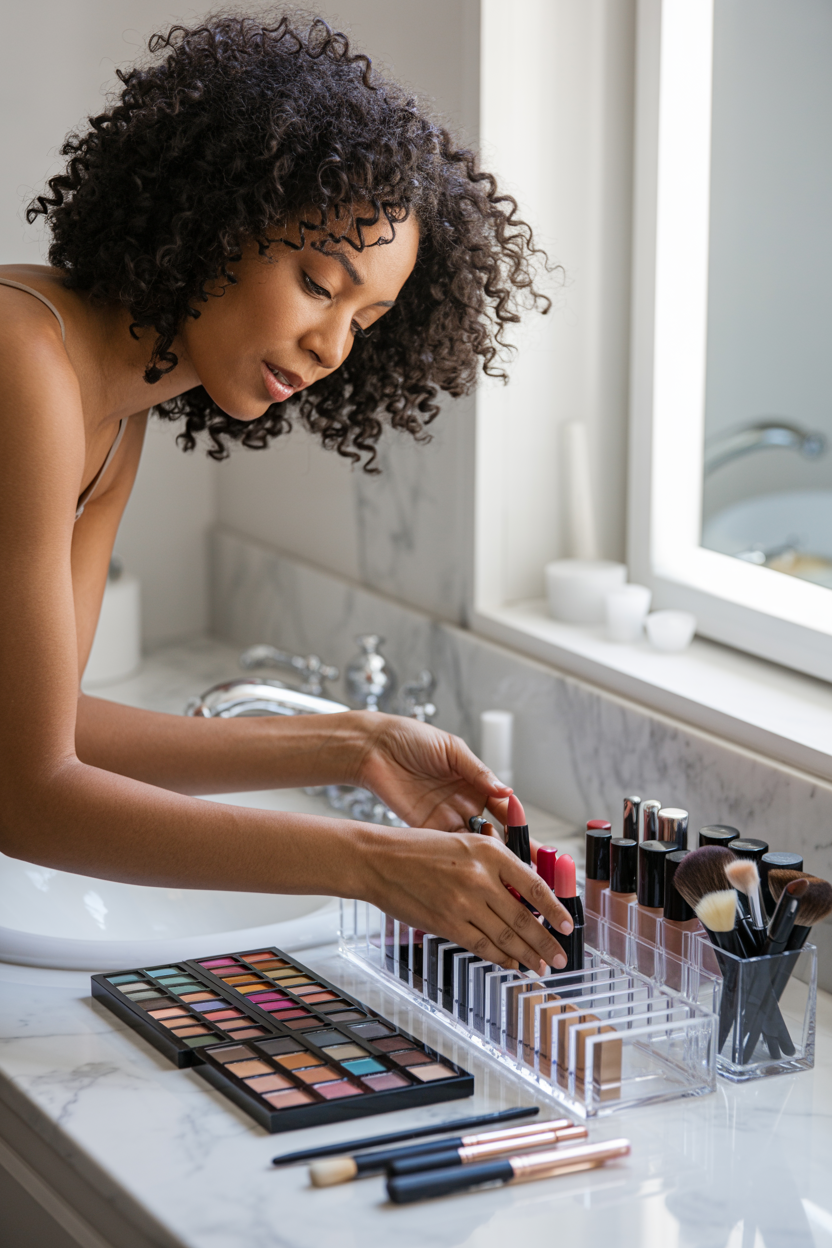
This is my personal favorite and the one I recommend most often. The idea is simple: keep everything you use regularly out on your counter in clear, compartmentalized organizers.
What you need:
- Clear acrylic organizers with multiple compartments (the Vtopmart 3-Tier Clear Makeup Organizer is fantastic for this)
- A rotating organizer for frequently-used products (try the Asayuee Rotating Makeup Organizer – it spins 360 degrees so you don’t have to dig)
- Small compartment dividers for lip products and eyeliners
The setup:
- Put your most-used products in the rotating organizer – these should be things you reach for almost daily
- Use the tiered clear organizer for everything else, grouping by type (all face products together, all eye products together)
- Keep tall products (foundations, setting sprays) in the back, short products (lipsticks, concealers) in the front
The beauty of this system is that everything is visible and accessible. No digging, no forgetting what you own, no decision paralysis about which container to open.
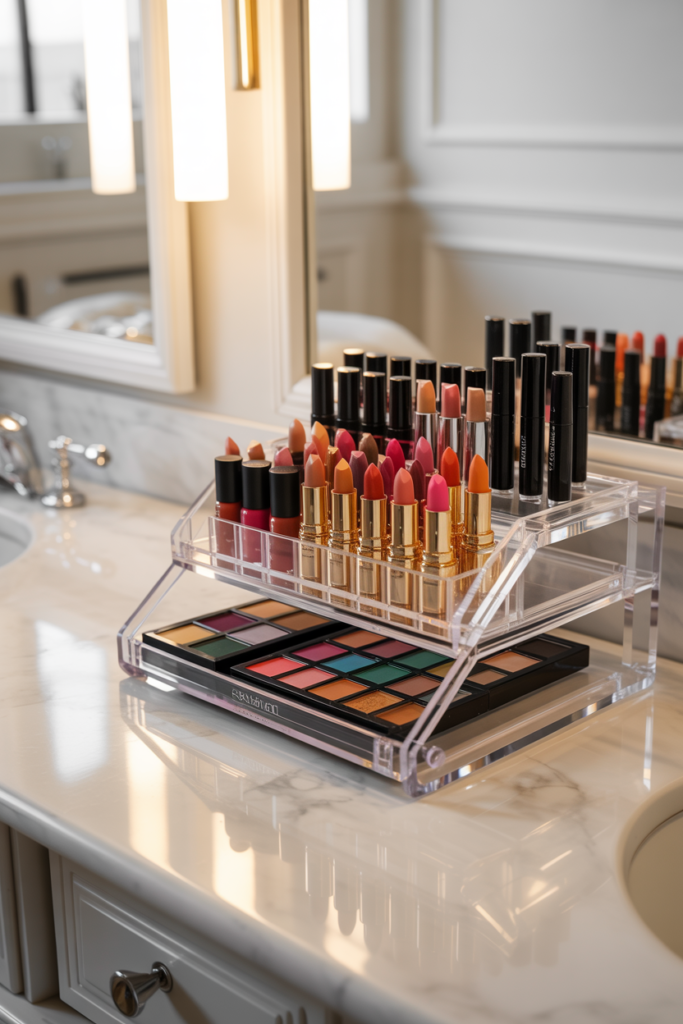
The “Curated Daily Essentials” System
If visual clutter stresses you out but you still need things visible, this is your solution. The trick is to drastically reduce what’s out on display to only your true daily essentials.
What you need:
- A small, attractive tray or single-tier organizer
- Storage elsewhere for non-daily products
- Clear vinyl pouches or small baskets for categorized backup products
The setup:
- Identify the 5-10 products you actually use every single day
- Keep ONLY those products visible on your tray
- Store everything else in clearly labeled pouches or containers nearby (but not in sight)
- Once a month, rotate in something new if you’re bored
This works well if you’re someone who gets overwhelmed by too many choices but still struggles with “out of sight, out of mind.” You’re seeing enough to remember makeup exists, but not so much that you freeze up trying to decide what to use.
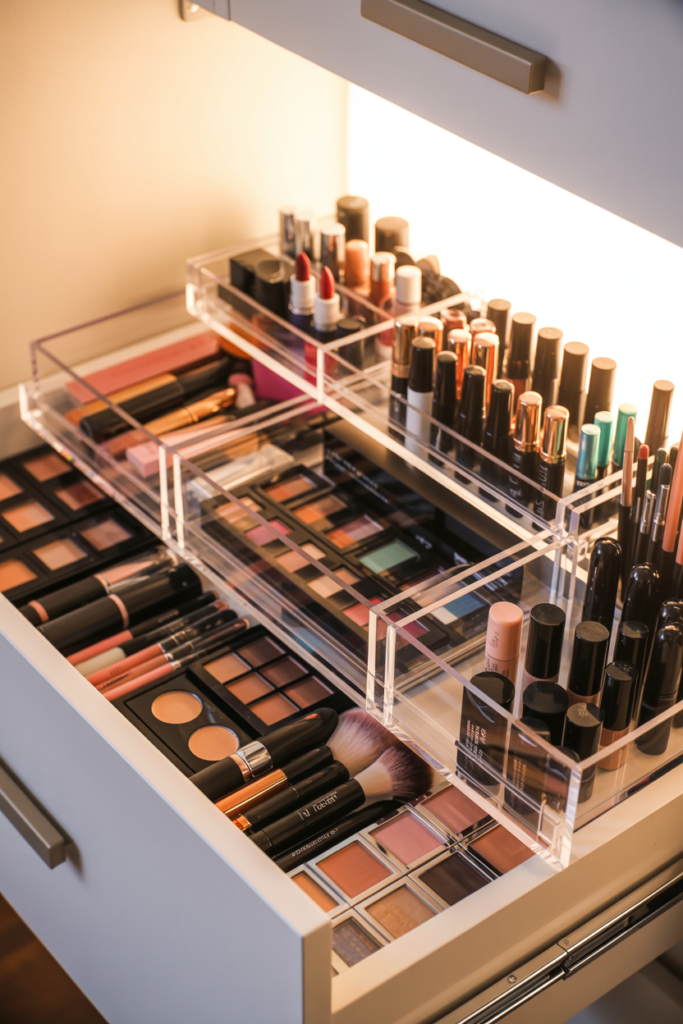
The “Open Drawer” System
If you have drawer space and want to use it, the key is making those drawers function more like open displays.
What you need:
- Drawer organizers with multiple small compartments
- Good lighting above or inside your drawers if possible
- Clear dividers or small boxes to create sections
The setup:
- Use shallow drawers, not deep ones (deep drawers become black holes)
- Fill the drawer with compartment organizers so products stand upright
- Arrange everything so you can see every single item when you open the drawer – nothing hidden behind anything else
- If possible, leave the drawer slightly open as a visual reminder
The trick here is to make the drawer function like a display case. When you open it, you should see everything at a glance, organized so nothing is hiding.
Specific Product Recommendations That Make Life Easier
Let’s talk about the actual organizers and tools that work best for ADHD brains. These aren’t just random recommendations—these are products specifically designed in ways that accommodate our needs.
For Maximum Visibility: Clear Acrylic Organizers
The gold standard for ADHD-friendly storage. Being able to see everything at a glance is crucial, and clear acrylic delivers on that promise.
The Vtopmart 3-Tier Clear Makeup Organizer is particularly great because it has multiple compartment sizes, drawers that glide smoothly (no wrestling with sticky drawers when you’re in a hurry), and anti-slip pads on the bottom so it won’t slide around.
For a more affordable option, check out basic clear acrylic organizers on Amazon. Even the budget versions work well as long as they’re transparent and have enough compartments.
For Easy Access: Rotating Organizers
If you’re constantly forgetting about products that end up in the back of your collection, a rotating organizer is life-changing. The Rotating Makeup Organizer with 8 Adjustable Layers lets you spin to find exactly what you need without moving anything around.
These are especially good for people who collect a lot of products but actually only use a portion of them regularly. Everything stays visible, but you’re not staring at an overwhelming wall of makeup.
For Lip Product Chaos: Small Compartment Organizers
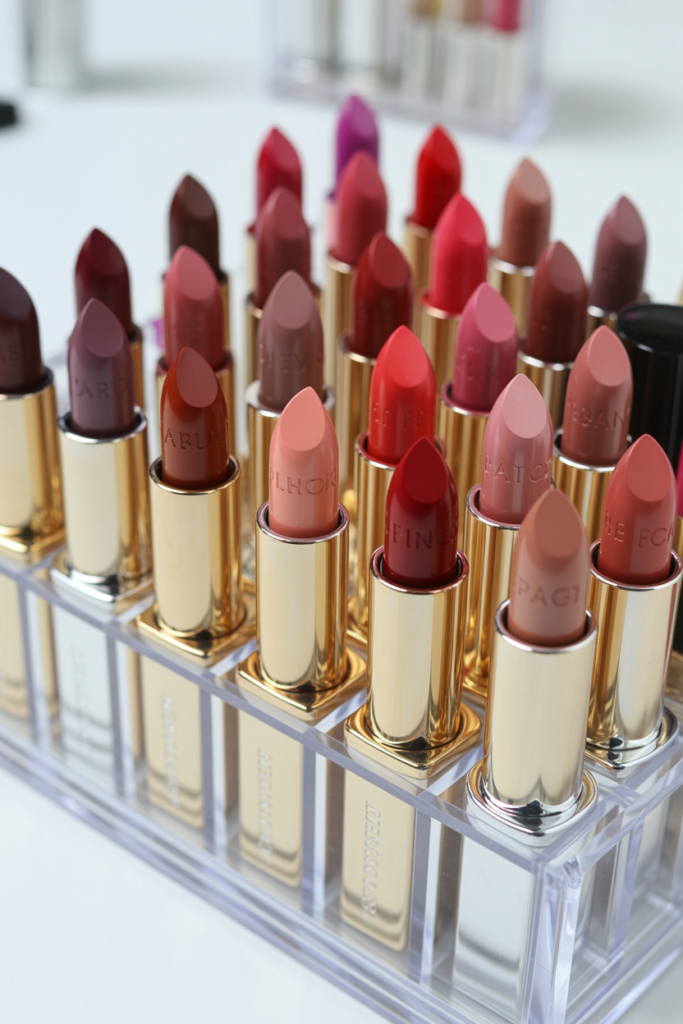
Lipsticks, lip liners, and lip glosses are the worst offenders for getting lost in the shuffle. Small compartment organizers (the kind with individual slots for each product) are absolutely essential.
Look for ones where each lipstick stands upright in its own spot. This prevents the domino effect where you pull out one lipstick and three others fall over.
For Multi-Purpose Storage: Tiered Organizers with Drawers
The StorBin 3 Drawers Makeup Organizer combines open storage with drawer storage, which is perfect if you need both visible and hidden storage options.
Use the top tiers for daily essentials and the drawers for backup products, sheet masks, or things you use less frequently. The key is those drawers have slide rails so they open smoothly—no fumbling required.
For Tiny Spaces: Wall-Mounted or Vertical Storage
Limited counter space is a real challenge. Wall-mounted magnetic boards or pegboards can be game-changers for small bathrooms or bedrooms.
You can find magnetic makeup boards on Amazon that let you stick magnetic stickers to the back of products and hang them vertically. Everything stays visible, and you’re using vertical space instead of precious counter real estate.
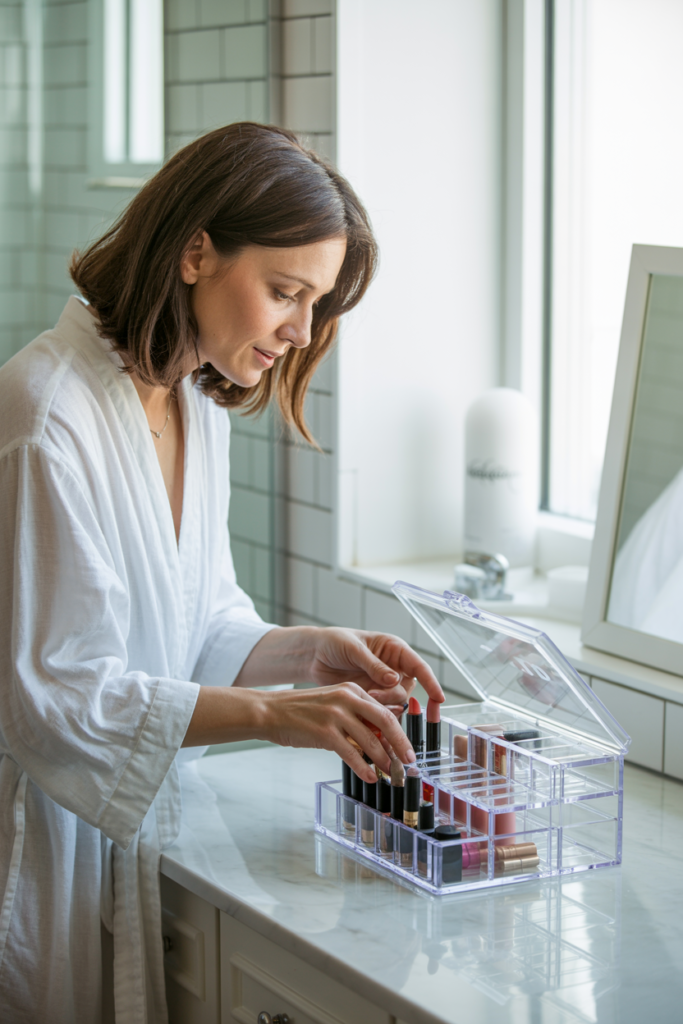
For Protection: Organizers with Lids
If you have issues with dust, pets knocking things over, or products getting damp in the bathroom, look for organizers with protective lids that still let you see inside. The Large Acrylic Makeup Organizer With Lid is dustproof and waterproof while maintaining visibility.
This is especially helpful if you share a bathroom and need to protect your makeup from spray from the shower or someone else’s products toppling onto yours.
Organizing By Type vs. By Routine
Here’s a question I get all the time: should you organize makeup by product type (all eyeshadows together, all lipsticks together) or by routine (morning routine products in one spot, evening products in another)?
The answer is: it depends on your specific ADHD challenges.
Organize By Type If:
- You tend to forget what products you own
- You like to switch up your looks frequently
- Visual categorization helps you feel less overwhelmed
- You want to avoid buying duplicates
Organize By Routine If:
- You have trouble with decision fatigue
- You prefer having a consistent daily routine
- You’re more likely to use products if they’re grouped together
- Mornings are particularly rushed for you
Personally, I use a hybrid approach. My daily essentials are organized by routine (everything I need for my basic face is together), but my “fun” products are organized by type so I can browse and experiment when I have time.
There’s no wrong answer here—experiment and see what actually gets you using your makeup consistently.
Maintaining Your System (Without Burning Out)
Okay, so you’ve set up an amazing organization system. Now what? How do you keep it from devolving back into chaos?
The secret is building maintenance into the system itself rather than relying on willpower.
Use “Homes” That Make Sense
Every product should have a specific spot, but that spot needs to be intuitive. If you find yourself constantly putting your mascara back in the wrong place, that’s not you being “bad” at organization—that’s the wrong spot for your mascara.
Pay attention to where you naturally try to put things and organize around that instinct.
Embrace “Close Enough”
Your products don’t need to be perfectly lined up or arranged by height or whatever. They just need to be in approximately the right area. This is an ADHD-friendly system, not a museum display.
If your lipsticks are in the lipstick section but they’re not perfectly aligned? That’s totally fine. Function over perfection, always.
Do Micro-Resets
Instead of waiting until everything is a disaster and then doing a huge reorganization, do tiny resets throughout the week. Spend 30 seconds putting things back after your makeup routine. That’s it. No deep clean, no total reorganization, just a quick “put things back in their general area.”
It’s much easier to maintain than trying to do a big reset once a month when things have gotten completely out of control.
Schedule a Monthly Purge
Set a reminder on your phone for once a month to spend 5-10 minutes going through your makeup. Toss anything dried out, expired, or that you genuinely never use. This keeps your collection manageable and prevents overcrowding.
The key is making it a regular appointment, not something you do “when you remember.”

Managing The Emotional Side
Let’s talk about something that doesn’t get discussed enough: the shame and frustration that comes with struggling to stay organized.
If you have ADHD, you’ve probably been told your whole life that you’re “messy” or “disorganized” or “lazy.” You might look at other people’s pristine vanities and feel like a failure. You might start organizing projects with enthusiasm only to abandon them days later and feel guilty about it.
Here’s what I want you to know: none of that means anything is wrong with you.
Your brain works differently. That’s not a flaw—it’s just a fact. And once you stop trying to organize like a neurotypical person and start organizing in ways that actually work for your ADHD brain, everything gets so much easier.
Some things that have helped me mentally:
Remember that organized doesn’t have to mean minimal. If you need more products visible to remember they exist, that’s fine. Your vanity doesn’t have to look like a minimalist Instagram aesthetic to be functional.
Don’t compare yourself to neurotypical organization. Those people who can keep everything in drawers and remember where it all is? Their brains work fundamentally differently than yours. You’re not failing at their system—their system just doesn’t work for you.
Celebrate small wins. Did you remember to put your products back in their general area today? That’s worth celebrating. Did you go a whole week without losing your favorite lipstick? Amazing.
Get rid of products you don’t use. I know, I know—but you might use them someday! Except you won’t, and they’re just taking up mental and physical space. If you haven’t touched something in six months, it’s okay to let it go.
Ask for help if you need it. If setting up an organization system feels completely overwhelming, it’s okay to ask a friend, family member, or even a professional organizer to help you set it up. Just make sure whoever helps you understands it needs to be ADHD-friendly.
Special Challenges and Solutions
Let’s troubleshoot some common ADHD-specific makeup organization problems.
“I buy duplicates because I forget what I have”
Solution: Take a photo of your collection and keep it on your phone. Before buying new makeup, check the photo. Or use a clear organizer system where you can literally see everything you own at a glance.
“I get hyperfocused on organizing and spend hours rearranging instead of actually doing anything else”
Solution: Set a timer. Give yourself 20 minutes to organize, and when the timer goes off, you’re done for the day. Come back to it tomorrow if needed. This prevents the “lost 6 hours reorganizing my lipsticks” phenomenon.
“I start projects with elaborate organization plans that I never finish”
Solution: Start smaller. Way smaller. Organize just your lipsticks today. That’s it. Not your whole collection—just lipsticks. Tomorrow, maybe do eyeshadows. Build slowly instead of trying to do everything at once.
“I forget to take my makeup off at night”
Solution: Keep makeup remover wipes right by your bed or wherever you end up at night. Make it so easy that you can do it half-asleep. The easier it is, the more likely you’ll do it.
“I impulse-buy makeup and then forget about it”
Solution: Implement a “new product” section in your organizer. When you buy something new, it goes there. Check that section regularly. Once you’ve used the product a few times, it can migrate to its permanent home. This also helps you remember to actually try the stuff you bought during your last dopamine-seeking shopping spree.
“My makeup space is in my bathroom and everything gets dusty/damp”
Solution: Look for organizers with lids or covers (like the ones mentioned earlier). Even better, store your makeup in your bedroom if possible. Humidity is not kind to makeup, and keeping it in a bathroom can shorten the lifespan of your products.
Creating Your Perfect ADHD-Friendly Setup: A Step-by-Step Plan
Alright, you’re ready to actually do this. Here’s how to create a system that works for you without getting overwhelmed.
Step 1: Dump everything out (and don’t panic). Put all your makeup in one place so you can see what you’re working with. Yes, this will look scary. That’s okay.
Step 2: Purge ruthlessly. Anything expired, dried out, or that you haven’t touched in 6+ months needs to go. Be honest with yourself. This is the only way to make the rest of the process manageable.
Step 3: Identify your true essentials. What do you actually use on a regular basis? Not what you wish you used, not what you used to use—what do you actually reach for now? These products get priority placement.
Step 4: Choose ONE organization principle. Are you organizing by type? By routine? By color? Pick one approach and stick with it. You can always change later, but starting with multiple systems is a recipe for failure.
Step 5: Get the right containers. Based on what you’ve read in this article, choose organizers that fit your space and your ADHD needs. Remember: visibility is key.
Step 6: Set it up with access in mind. Most-used items should be easiest to reach. Less-used items can be slightly further back or on higher tiers. Never hide anything completely unless you truly don’t care if you never use it again.
Step 7: Use it for a week. Live with your system for at least a week before making any changes. Notice what’s working and what’s frustrating you.
Step 8: Make small adjustments. After a week, tweak anything that’s not working. Move things around. Add or remove dividers. This is about finding what works for YOUR brain, not following a preset system.
Bottom Line: Your System Should Serve You, Not the Other Way Around
The most important thing I want you to take away from this is that there’s no “right” way to organize your makeup if you have ADHD. There’s only what works for you, right now, with your current collection and living situation and energy levels.
Your organization system should make your life easier, not harder. It should reduce stress, not create it. And it should be flexible enough to adapt when your needs change.
If something isn’t working, you’re not failing—the system is failing you. And that means it’s time to try something different.
Start small. Be patient with yourself. Celebrate the wins. And remember that even if your vanity looks nothing like those perfect Instagram setups, if it’s functional for you, it’s perfect.
You’ve got this.
This post contains affiliate links, which means I may earn a small commission if you purchase through these links at no extra cost to you. I only recommend products I genuinely believe in and would use myself. Thank you for supporting Blush Hour!