Managing Sensitive Skin: Products and Ingredients to Avoid
If your skin throws a tantrum every time you try a new product, you’re definitely not alone. Sensitive skin can feel like navigating a minefield—one wrong ingredient and boom, you’re dealing with redness, stinging, or that awful tight, itchy feeling that makes you want to splash cold water on your face immediately.
I’ve been there. After years of trial and error (and way too many products that ended up in the trash), I’ve finally figured out what works and what absolutely doesn’t. The good news? Once you know what to avoid, managing sensitive skin becomes so much easier.
Let’s break down everything you need to know about sensitive skin, the ingredients that are likely causing problems, and the gentle products that actually work.
What Even Is Sensitive Skin?
Here’s the thing about sensitive skin—it’s not technically a medical diagnosis. It’s more of a description of how your skin reacts to products, weather, stress, and basically everything else life throws at you.
If you’ve experienced any of these, you likely have sensitive skin:
- Stinging or burning when you apply products
- Redness that shows up out of nowhere
- Dry, flaky patches that won’t go away
- Itchiness or tightness
- Reactions to seemingly innocent products
- Your skin freaking out when the weather changes
The root cause? Your skin barrier isn’t as strong as it could be. Think of your skin barrier like a brick wall—when it’s healthy, it keeps the good stuff in (moisture) and the bad stuff out (irritants). When it’s compromised, everything gets through, and that’s when your skin starts reacting to, well, everything.
The Biggest Culprits: Ingredients to Avoid
Okay, let’s talk about the ingredients that are most likely causing your sensitive skin to revolt. I’m going to break these down so you know exactly what to look for on ingredient labels.
Fragrance (Including Essential Oils)
This is enemy number one for sensitive skin. Fragrances might make your moisturizer smell like a spa, but they’re one of the most common causes of skin reactions and allergic contact dermatitis.
Here’s what makes this tricky: products labeled “unscented” can still contain fragrance—companies sometimes add a masking fragrance to cover up the natural scent of ingredients. You want products labeled “fragrance-free.”
And yes, this includes essential oils. I know they sound natural and gentle, but essential oils like lavender, citrus, and peppermint can be seriously irritating to sensitive skin. Natural doesn’t automatically mean gentle.
What to look for on labels:
- Parfum or fragrance
- Essential oils (lavender oil, tea tree oil, citrus oils)
- Plant extracts added for scent
Alcohol (The Drying Kind)
Not all alcohols are bad—some fatty alcohols like cetyl alcohol and stearyl alcohol are actually moisturizing. But the drying alcohols? They’re terrible for sensitive skin.
Drying alcohols strip your skin of its natural oils, leaving it dehydrated, irritated, and more vulnerable to everything else. They’re especially common in toners and gel products.
What to avoid:
- SD alcohol
- Denatured alcohol
- Isopropyl alcohol
- Ethanol (when listed near the top of ingredients)
What’s okay:
- Cetyl alcohol
- Cetearyl alcohol
- Stearyl alcohol
Sulfates
Sulfates are what make your cleanser foam and lather. They’re effective at removing dirt and oil, but they’re too effective—they strip your skin barrier and can cause serious dryness and irritation.
The worst part? Sulfates are in everything from face washes to body washes to shampoo. Once I switched to sulfate-free cleansers, my skin stopped feeling tight and dry after washing.
What to avoid:
- Sodium lauryl sulfate (SLS)
- Sodium laureth sulfate (SLES)
Physical Exfoliants and Harsh Scrubs
I know that face scrub with the little beads feels satisfying, but if you have sensitive skin, physical exfoliation is probably doing more harm than good. Those scrubbing particles create micro-tears in your skin, damage your barrier, and make sensitivity worse.
Even “gentle” scrubs can be too much. If your skin is already irritated, adding friction is like pouring salt in a wound.
High Concentrations of Active Acids
Don’t get me wrong—chemical exfoliants like AHAs (glycolic acid, lactic acid) and BHAs (salicylic acid) can be amazing for your skin. But if you have sensitive skin, high concentrations or frequent use can cause redness, peeling, and irritation.
The key is starting with low concentrations and using them less frequently. Your sensitive skin can still benefit from these ingredients—you just need to be more careful about how you introduce them.
Start with lower percentages:
- Lactic acid: 5% or less
- Glycolic acid: Avoid or use 5% or less
- Salicylic acid: 0.5% to 1%
Retinoids (Use with Caution)
Retinoids are incredible for anti-aging and acne, but they’re also powerful and can be really irritating for sensitive skin. That doesn’t mean you can’t use them—it just means you need to ease into them slowly and choose gentler formulations.
If you’re set on using retinol, start with a low concentration (0.25% or 0.3%), use it only 1-2 times per week, and always buffer it with moisturizer.
Other Common Irritants
- Parabens: Some people with sensitive skin react to these preservatives
- Propylene glycol: Can cause irritation and disrupt moisture balance
- Synthetic dyes: Listed as FD&C or D&C followed by a color and number
- Benzoyl peroxide: Great for acne, but can be too harsh for sensitive skin in higher concentrations
The Best Gentle Products for Sensitive Skin
Now for the good part—what you should be using. These products are formulated specifically for sensitive skin and have helped countless people (including me) calm their reactive skin.
Best Gentle Cleanser: CeraVe Hydrating Facial Cleanser
CeraVe Hydrating Facial Cleanser is honestly a lifesaver for sensitive skin. It’s got three essential ceramides that help restore your skin barrier, plus hyaluronic acid for hydration.
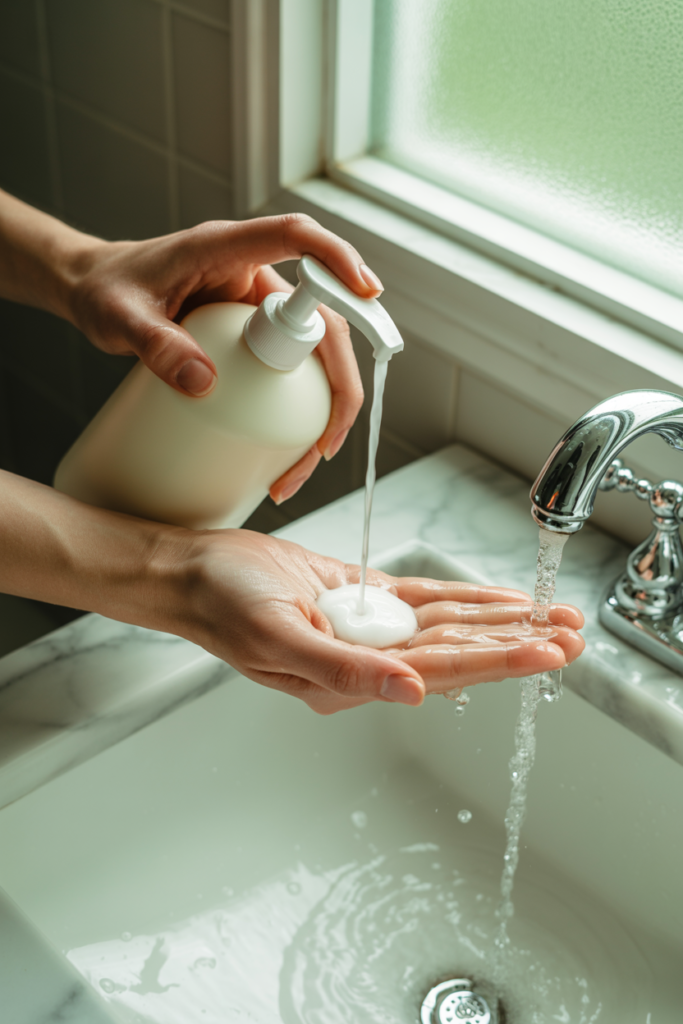
What I love about it: It doesn’t foam (which means no sulfates), it’s completely fragrance-free, and it’s accepted by the National Eczema Association. It’s so gentle you can use it on your face and body, and it removes makeup without stripping your skin.
The texture is like a creamy lotion that melts into your skin. You massage it in with lukewarm water, rinse, and your skin feels clean but not tight. This is the cleanser I recommend to literally everyone with sensitive skin.
Key features:
- Fragrance-free and non-comedogenic
- Contains ceramides to repair skin barrier
- Hyaluronic acid for moisture retention
- Won’t disrupt your skin’s natural pH
If you prefer a foaming cleanser, CeraVe Hydrating Cream-to-Foam Cleanser starts as a cream and transforms to a gentle foam. It’s got the same great ingredients but gives you that satisfying foam texture.
Alternative Gentle Cleanser: La Roche-Posay Toleriane Hydrating Gentle Face Cleanser
La Roche-Posay Toleriane Hydrating Gentle Cleanser is another fantastic option, especially if your skin is on the drier side.
It’s formulated with niacinamide (which soothes inflammation), ceramide-3, and La Roche-Posay’s prebiotic thermal water. The formula is pH-balanced and clinically tested for sensitive skin.
This cleanser has a creamy texture that works into a light lather. It removes makeup and impurities without stripping moisture, and it leaves your skin feeling comfortable and hydrated.
Why it works:
- Niacinamide helps calm inflammation
- Ceramides support skin barrier
- Dermatologist tested and recommended
- Suitable for normal to dry sensitive skin
For oily or combination sensitive skin, try La Roche-Posay Toleriane Purifying Foaming Cleanser instead. It’s formulated to remove excess oil without over-drying.
Best Moisturizer: CeraVe Moisturizing Cream
When your skin barrier is compromised, you need a moisturizer that’s going to repair and protect it. CeraVe Moisturizing Cream does exactly that.
This rich, non-greasy cream contains ceramides, hyaluronic acid, and CeraVe’s MVE technology, which releases moisturizing ingredients gradually for 24-hour hydration. It’s fragrance-free, non-comedogenic, and accepted by the National Eczema Association.
Use it on your face, body, or anywhere your skin needs extra TLC. It absorbs quickly without feeling heavy, and it works under makeup beautifully.
Best for Dry Sensitive Skin: La Roche-Posay Lipikar AP+ Triple Repair Moisturizing Cream
If your sensitive skin is also super dry or eczema-prone, you need something more intensive. This cream is formulated with shea butter, niacinamide, and glycerin to provide intense moisture and repair your skin barrier.
It’s specifically designed for very dry, rough, and irritated skin. The formula helps relieve itching and discomfort while protecting your skin from further damage.
How to Build a Sensitive Skin Routine
Building a routine for sensitive skin is all about simplicity. More products = more chances for irritation. Here’s what your basic routine should look like:
Morning:
- Gentle cleanser (like CeraVe Hydrating Cleanser)
- Simple moisturizer
- Mineral sunscreen (SPF 30 or higher)
Evening:
- Gentle cleanser
- Treatment product (if using—start slow!)
- Rich moisturizer
Key rules:
- Introduce new products one at a time (wait 2-3 weeks between new products)
- Patch test everything on your inner arm or behind your ear first
- Use lukewarm water—hot water strips your skin
- Pat dry instead of rubbing with your towel
- Less is more—don’t overload your skin
What to Do When Your Skin Reacts
Even with the gentlest products, sometimes your skin will have a reaction. Here’s what to do:
Immediate steps:
- Stop using all new products immediately
- Rinse your face with cool water
- Apply a simple, gentle moisturizer you know your skin tolerates
- Avoid makeup until the reaction calms down
For the next few days:
- Strip your routine back to just cleanser and moisturizer
- Skip any active ingredients (acids, retinol, etc.)
- Use a cool compress if there’s inflammation
- Don’t pick or touch your face
If the reaction is severe (painful swelling, blistering, or doesn’t improve in a few days), see a dermatologist. You might be having an allergic reaction that needs medical attention.
Reading Labels Like a Pro
The most important skill for managing sensitive skin? Learning to read ingredient labels before you buy anything.
Quick tips:
- Ingredients are listed in order of concentration (highest to lowest)
- If an irritant is in the first 5-7 ingredients, skip it
- Look for “fragrance-free,” not just “unscented”
- Check for trigger ingredients specific to your skin
- Don’t assume “natural” or “organic” means gentle
Create a list on your phone of ingredients you know irritate your skin. Take it shopping with you so you can quickly scan labels before buying.
My Current Sensitive Skin Routine
Since you’re probably wondering, here’s what I’m actually using right now:
Morning:
Evening:
- CeraVe Hydrating Cleanser
- CeraVe Moisturizing Cream (the one in the tub)
That’s it. Four products. My skin has never looked better or felt more comfortable. I’m not dealing with constant redness, my skin barrier is strong, and I can actually enjoy my skincare routine instead of dreading it.
Final Thoughts
Managing sensitive skin isn’t about finding the fanciest products or having a 10-step routine. It’s about identifying your triggers, avoiding irritants, and sticking with gentle, effective products that support your skin barrier.
Start by switching out your cleanser and moisturizer for something fragrance-free and sulfate-free. The CeraVe Hydrating Facial Cleanser is honestly the best place to start—it’s affordable, effective, and works for almost everyone.
Give your skin time to heal. It might take a few weeks of using gentle products before you notice a real difference, but I promise it’s worth the patience. Your skin barrier can absolutely recover—it just needs the right support.
You deserve skincare that doesn’t hurt, products that actually work, and skin that feels comfortable. With the right approach, sensitive skin is totally manageable. Go easy on yourself, be patient with your skin, and remember that less is usually more.
Disclosure: This post contains affiliate links, which means I may earn a small commission if you make a purchase through these links at no additional cost to you. I only recommend products I genuinely love and think you’ll enjoy too! Also, I’m just a beauty lover, not a dermatologist. If your skin is having a serious freak-out, don’t hesitate to reach out to a professional!



One Comment